No Implied Disarmament: State-Imputed Exclusion and Private-Property Carry Defaults After Bruen
After Bruen, the question is whether a State may treat every silent proprietor as having already barred licensed carry on private property held open to the public.

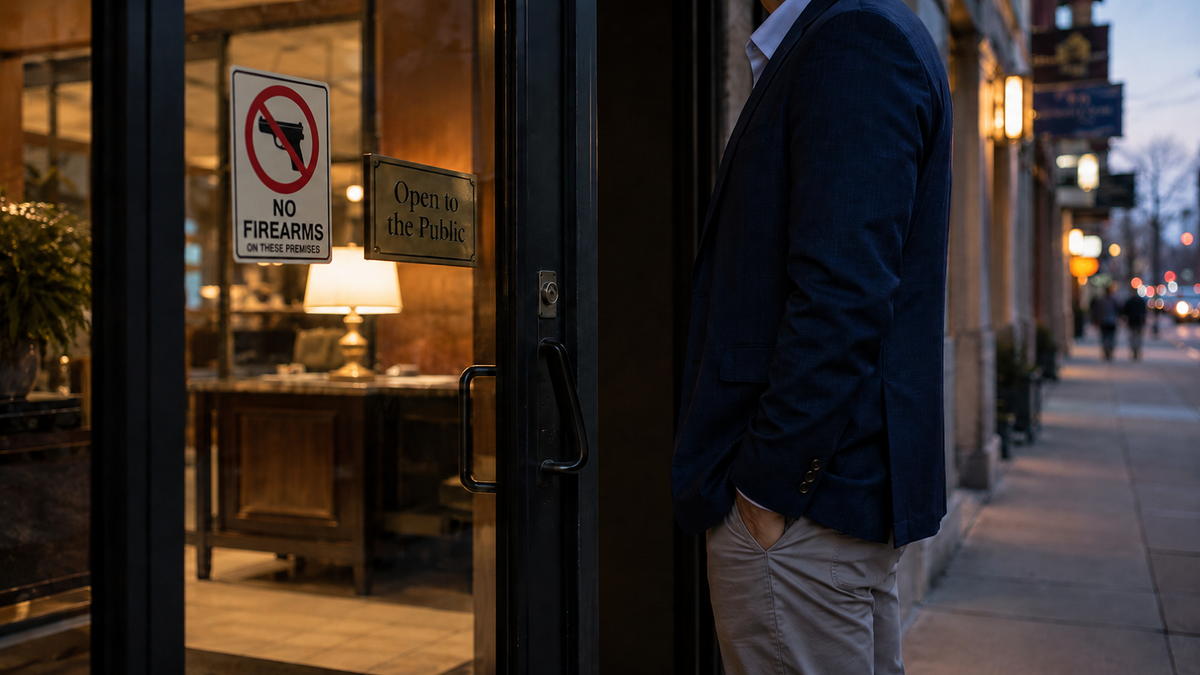
Table of Contents
- Introduction
- I. The Question in Wolford
- II. Public Carry After Heller, McDonald, Bruen, and Rahimi
- III. State-Imputed Exclusion and the Storefront Threshold
- IV. Trespass, Implied License, and Owner Choice
- V. The Historical Record
- VI. The Contrary Arguments
- VII. The Rule
- Conclusion
- Notes
Introduction
The Second Amendment protects “the right of the people to keep and bear Arms.”[1] In New York State Rifle & Pistol Association v. Bruen, the Supreme Court held that this guarantee protects the right of ordinary, law-abiding citizens to carry handguns outside the home for self-defense.[2] The question now before the Court in Wolford v. Lopez concerns the point at which that right meets private property held open to the public.[3]
Hawaii answered that question through Act 52, signed on June 2, 2023.[4] The Act makes licensed firearm carry unlawful on another’s private property unless the owner, lessee, operator, or manager gives express authorization.[5] That authorization may come through unambiguous written or verbal permission, or through clear and conspicuous signage allowing firearms.[6] Without that authorization, entry while armed is a misdemeanor.[7] New York adopted a similar rule in its Concealed Carry Improvement Act.[8]
This Article argues that a State may enforce an owner’s expressed decision to exclude firearms.[9] It may enforce posted conditions of entry, verbal instructions, lease provisions, membership rules, and ordinary trespass principles.[10] It may also define reasonable forms of notice.[11] What it may not do is convert owner silence into a firearms-specific criminal command on private property held open to the public. When the State supplies the exclusion and attributes it to every silent proprietor, it burdens public carry while presenting the burden as private choice.[12]
How the rule is named helps identify its operation. For purposes of this Article, the challenged rule is referred to as “state-imputed exclusion.”[13] The term describes a law that attributes a no-carry decision to private owners who have said nothing.[14] The rule has also acquired a more vivid name, the vampire rule.[15] Petitioners have used that phrase because the statute treats the armed citizen like the folkloric figure who may enter only after invitation.[16] The image remains useful so long as it reflects, rather than overshadows, the legal limits. Historically, the threshold for a household and that for a storefront have never been identical.[17] Entry into a dwelling ordinarily requires consent; by contrast, a public-facing business ordinarily extends a license to enter for lawful purposes unless the owner withdraws or conditions that license.[18][19]
At its core, the distinction is that owner-controlled exclusion operates through established principles of property law, while state-imputed exclusion imposes a firearms-specific criminal default.[20] The owner’s decisions to exclude remain valid exercises of private authority.[21] By contrast, when the State attributes a no-carry preference to every silent proprietor and penalizes licensed carriers for failing to secure affirmative permission, it transforms property law into an instrument for enforcing a statewide no-carry default, as opposed to reflecting actual owner intent.[22] That approach narrows the right recognized in Bruen while presenting the burden as if it were the owner’s.[23]
This Article proceeds in seven parts. Part I describes Hawaii’s rule and the split among the courts of appeals.[24] Part II sets out the governing Second Amendment framework after Heller, McDonald, Bruen, and Rahimi.[25] Part III explains why the vampire-rule label captures the statute’s threshold operation.[26] Part IV develops the property-law distinction between implied license and owner exclusion.[27] Part V tests the historical analogues offered to defend the modern default rule. Part VI answers the principal contrary arguments. Part VII states the rule that property held open to the public carries an implied license to enter for lawful purposes unless the owner gives reasonably clear notice excluding firearms.[28]
I. The Question in Wolford
Hawaii’s statute speaks in direct terms. A licensed carrier may not intentionally, knowingly, or recklessly enter or remain on another person’s private property while carrying a firearm unless the owner, lessee, operator, or manager has provided express authorization.[29] The statute applies to private property of another person. The question presented in Wolford concerns that rule as applied to private property held open to the public.[30] A store, restaurant, gas station, hotel, laundromat, church, parking lot, or similar place falls within the ordinary reach of public life, yet the licensed carrier must obtain affirmative permission before entering while armed.[31]
The legislature’s findings help explain the statute’s design.[32] Act 52 says it respects private owners’ choices, then states that community sentiment and broadly shared preferences support a default rule under which private entities must opt in to authorize licensed carry.[33] That finding identifies the constitutional problem. The legislature supplied the default before any owner acted.[34] It established disarmament as the background rule and imposed criminal consequences on the patron for the owner’s silence.[35]
New York’s statute used the equivalent structure.[36] It made it a crime to enter or remain on private property with a firearm, rifle, or shotgun when the person knows or reasonably should know that the owner or lessee has not permitted possession by clear signage or express consent.[37] Like Hawaii, New York turned the absence of permission into criminal exposure.[38]
The courts of appeals divided over that approach.[39] At the preliminary-injunction stage, the Ninth Circuit reversed the injunction as to Hawaii’s private-property rule.[40] The panel recognized that the rule altered the prior default and that the regulated conduct likely falls within the Second Amendment’s text.[41][42] It nonetheless concluded that plaintiffs were unlikely to succeed because the State had shown sufficient historical support.[43]
The Second Circuit reached the opposite conclusion in Christian v. James.[44] There, the court affirmed a permanent injunction against New York’s private-property provision as applied to property open to the public.[45] The court held that New York had failed to carry its burden under Bruen because the challenged rule did not fit the Nation’s historical tradition of firearm regulation.[46] It also rejected the Ninth Circuit’s reading of the relevant historical materials.[47]
The split presents a limited question.[48] May the State convert owner silence into a criminal no-carry command on property otherwise open to the public? The better answer is no.[49] The State may protect private exclusion.[50] It may not impute exclusion to every owner and then call that imputation trespass law.[51]
II. Public Carry After Heller, McDonald, Bruen, and Rahimi
Before considering Hawaii’s private-property default, it is necessary to establish the right against which that default must be measured. The Supreme Court’s modern Second Amendment cases proceed in sequence from possession in the home, to incorporation against the States, to carry outside the home, and finally to the historical method used to evaluate later regulations.[52] That sequence supplies the framework for the question in Wolford.[53]
In District of Columbia v. Heller, the Court considered whether the Second Amendment protects an individual right to possess a firearm apart from service in a militia.[54] The challenged District of Columbia law prohibited the possession of usable handguns in the home, and the Court resolved the case through an examination of the Amendment’s text, the ordinary meaning of “keep” and “bear,” the prefatory clause, founding-era sources, post-ratification commentary, and nineteenth-century cases.[55] That inquiry led the Court to recognize an individual right to possess arms for lawful purposes, with self-defense described as central to the right.[56] Because the District’s law prevented that use in the home, the Court held that it violated the Second Amendment.[57]
Two years later, McDonald v. City of Chicago addressed whether the right recognized in Heller binds the States.[58] The case arose from handgun restrictions adopted by Chicago and Oak Park after Heller.[59] In holding that the Fourteenth Amendment makes the Second Amendment applicable to the States, the Court traced the right to keep and bear arms through American history, including Reconstruction-era concerns about state efforts to disarm freedmen.[60] After McDonald, the right recognized in Heller became enforceable against state and local governments.[61]
Bruen then addressed the right outside the home.[62] New York had required applicants for public-carry licenses to show proper cause before receiving permission to carry a handgun in public.[63] The Court held that the Second and Fourteenth Amendments protect an individual’s right to carry a handgun for self-defense outside the home.[64] It also rejected the means-end framework that many lower courts had used after Heller and McDonald.[65] Under Bruen, once the Second Amendment’s text covers the conduct, the government must show that its regulation is consistent with the Nation’s historical tradition of firearm regulation.[66]
Applied to Wolford, Bruen requires a court to identify the regulated conduct with care.[67] The conduct is licensed handgun carry by an ordinary, law-abiding citizen while entering property held open to the public.[68] That setting differs from a home, farm, enclosed field, or other premises closed to ordinary public entry.[69] Stores, restaurants, gas stations, hotels, laundromats, and similar establishments are privately owned, yet they operate through a general invitation to the public.[70] Their private ownership raises a property-law question about the owner’s power to exclude.[71] It does not, without additional facts, remove the conduct from public carry.[72] Until the owner chooses to exclude firearms, the carrier remains engaged in public carry of the kind Bruen protects.[73]
If the right recognized in Bruen were limited to the storefront threshold, its practical force would be sharply diminished.[74] A licensed carrier may carry lawfully on a public sidewalk.[75] Under Hawaii’s rule, the same person commits a misdemeanor by entering an ordinary store while armed unless the owner has affirmatively authorized firearms.[76] Nothing about the person, firearm, license, or conduct has changed in any meaningful constitutional sense. The change in legal status arises from the State’s decision to make disarmament the default rule for public-facing private property.[77]
United States v. Rahimi did not retreat from Bruen’s framework.[78] The Court there considered a federal statute that disarmed a person subject to a domestic-violence restraining order after a court found that he posed a credible threat to another’s physical safety.[79] The Court upheld the statute as applied to Rahimi and explained that historical analogy asks how and why the modern law burdens the right.[80] The restriction approved in Rahimi was tied to judicial process, a finding of dangerousness, and a temporary disarmament rule directed at a person found to pose a threat.[81]
Hawaii’s private-property default lacks those features.[82] It contains no comparable judicial finding, individualized threat determination, or conduct indicating danger.[83] It applies to licensed carriers as a class and reaches the ordinary locations of public life.[84] The statute therefore burdens public carry in a different manner and for a different reason than the law upheld in Rahimi.[85] The federal law in Rahimi addressed a person found dangerous by a court.[86] Hawaii’s law addresses the licensed carrier as such and treats his entry onto public-facing private property as unlawful unless the owner affirmatively permits it.[87]
Taken together, Heller, McDonald, Bruen, and Rahimi provide the relevant rule.[88] The Second Amendment protects an individual right to keep and bear arms; that right applies against the States; it includes public carry for self-defense; and a State that burdens conduct covered by the Amendment must justify its law through text, history, and tradition.[89] Hawaii’s private-property default therefore cannot be sustained merely by invoking private ownership.[90] The State must show a historical tradition allowing it to treat owner silence as a criminal no-carry command on property otherwise held open to the public.[91]
III. State-Imputed Exclusion and the Storefront Threshold
The vampire-rule label helps describe the statute’s operation, but it should be used only after the legal setting is apparent.[92] Petitioners use the phrase because Hawaii’s rule treats the armed citizen as someone who may enter property held open to the public only after invitation.[93] In that limited sense, the phrase is accurate. The statute takes a permission structure associated with entry into a home and carries it into the marketplace, where property law has traditionally treated public-facing premises differently.[94]
The difference begins with the character of the premises.[95] A dwelling does not invite the public to enter merely by existing, and the homeowner need not announce conditions in advance before excluding strangers.[96] Public-facing businesses operate under another baseline.[97] Stores, restaurants, gas stations, hotels, laundromats, and similar establishments remain privately owned, and their owners retain authority to limit entry, impose conditions, or revoke permission.[98] Their ordinary operation, however, extends a general invitation to members of the public who enter for lawful purposes.[99] That general invitation is the point at which the Second Amendment question arises, because licensed carry is already lawful public conduct after Bruen unless the owner chooses to exclude it.[100]
Hawaii’s statute changes that baseline for one class of entrants and one form of protected conduct.[101] A person may enter a gas station to buy fuel, a grocery store to buy food, or a laundromat to wash clothes under the ordinary invitation those businesses extend to the public.[102] If that same person carries under a state license, the ordinary invitation disappears unless the owner has provided express authorization.[103] The statute therefore treats the public-facing business like a dwelling at the very moment the licensed carrier crosses the threshold.[104] Exclusion in this context reflects no posted sign, verbal instruction, lease term, membership condition, or explicit demand to leave.[105] It reflects the State’s choice to treat silence as a criminal no-carry command.[106]
That shift gives the vampire rule its constitutional significance.[107] Bruen recognized a right to carry handguns outside the home for self-defense.[108] Public carry includes movement through the ordinary places where public life occurs, many of which are privately owned but open to lawful entry.[109] If the right exists on streets and sidewalks but disappears at the entrances to stores, restaurants, gas stations, hotels, and parking lots unless each owner gives affirmative permission, then the right has been reduced to a narrow path between destinations.[110] At that point, the State is no longer enforcing an actual owner’s decision.[111] It is substituting its own policy judgment, supplying the exclusion in advance, and attributing it to the proprietor regardless of any expressed intent.[112]
Hawaii’s strongest answer begins with the owner’s right to exclude.[113] That premise is sound as a statement of private authority.[114] An owner may exclude firearms, condition entry, direct agents to deny admission, revoke permission after entry, and rely on ordinary trespass principles against a carrier who disregards those terms.[115] The question presented arises before any such owner-specific act.[116] It asks whether the State may attribute an exclusion decision to every owner who has remained silent and then punish the licensed carrier for failing to obtain affirmative permission that ordinary entrants do not need.[117]
Read in that context, the vampire rule is best understood as a description of state-imputed exclusion because it turns on who gives legal force to the carrier’s exclusion at the threshold.[118] A posted no-guns sign, a verbal instruction by a manager, or another owner-specific condition of entry communicates private choice by tying the exclusion to an act of the proprietor.[119] A silence-as-exclusion statute operates differently.[120] It gives legal force to private silence and imposes a criminal consequence selected by the State.[121] The constitutional inquiry therefore turns on the source of the no-carry command.[122] Owner-supplied exclusion falls within ordinary property and trespass law.[123] State-supplied exclusion through a firearms-specific default burdens public carry and must be justified under Bruen’s historical-tradition test.[124]
IV. Trespass, Implied License, and Owner Choice
Property law supplies the proper baseline for understanding Hawaii’s statute.[125] The ordinary law of trespass begins with the owner’s authority to decide who may enter and under what conditions.[126] That authority has different consequences depending on the character of the premises.[127] A home, farm, plantation, enclosed field, or private club does not carry the same legal invitation as an inn, public house, shop, restaurant, gas station, hotel, or similar establishment held open to ordinary public entry.[128] In the latter setting, the owner retains the power to limit or revoke entry, but the premises themselves are offered to the public for lawful purposes.[129] It is from that invitation, rather than from a general right to enter all private property, that the implied-license principle arises.[130]
That principle does not require an owner to admit firearms.[131] It instead identifies the legal position of the entrant before the owner has acted.[132] A proprietor who wishes to exclude firearms may do so through the ordinary means by which property owners communicate conditions of entry: a posted sign, a verbal instruction, a direction given through an employee, a lease provision, a membership rule, a ticket condition, or a demand that the entrant leave.[133] Once the owner communicates such a condition, the carrier no longer stands in the same position as other members of the public invited onto the premises.[134] At that point, ordinary trespass law may enforce the owner’s decision, and the Second Amendment supplies no license to disregard the exclusion.[135]
The question in Wolford arises before any such owner-specific act.[136] The owner has not posted a sign, given an instruction, written a rule, revoked entry, or demanded departure.[137] Hawaii nonetheless treats the licensed carrier as unlawfully present because he carries a firearm.[138] This changes the function that trespass law performs.[139] At common law, as the Second Circuit explained in Christian, entry onto property held open to the public was not treated the same way as entry onto a home or farm.[140] Blackstone gave the example of an inn or public house, where the proprietor’s decision to hold the premises open supplied a general license to enter.[141] The Second Circuit then pointed to State v. Boone, where the North Carolina Supreme Court overturned a felonious-entry conviction because the defendant entered a store while it was open to the public, and State v. Martin, where the South Carolina Supreme Court recognized that the public has an implied license to enter a retail store and many other places of business.[142] Placed in historical context, Hawaii’s statute exceeds traditional trespass enforcement by transforming the State’s firearms-specific default into a substitute for an owner’s express withdrawal of the ordinary invitation.[143] As a result, individuals who would otherwise be lawfully present under the public-facing character of the premises face criminal liability based solely on a legal fiction created by the State.[144]
At argument, the United States framed the burden as a firearms-specific redefinition of trespass.[145] In response to Justice Jackson, Deputy Solicitor General Sarah Harris stated that Hawaii’s rule tells licensed carriers they are no longer presumptively allowed to carry at places such as gas stations or laundromats.[146] Justice Gorsuch later described the rule as flipping the longstanding implied-license presumption only for firearms, and Harris agreed that the rule singles out a particular right and a particular group.[147] That description captures the structure of Hawaii’s law.[148] Rather than applying uniformly to all entrants or forms of conduct, the rule specifically targets licensed public carry, rendering that conduct unlawful unless the owner takes the additional step of affirmatively restoring permission that is otherwise presumed for other lawful entrants based on the public-facing nature of the premises.[149]
Hawaii’s permission answer confirms the burden.[150] On the State’s account, the licensed carrier may ask for approval before entering a store, restaurant, gas station, hotel, laundromat, or other place held open to the public.[151] That answer assumes the very change in legal status that the statute creates.[152] Ordinary entrants do not seek individualized permission before crossing those thresholds.[153] They enter because the premises have been opened to the public for lawful purposes.[154] Hawaii requires a different form of permission only when the entrant is armed under a license.[155] The result is a rule in which the exercise of public carry depends on a sequence of private dispensations from owners, managers, cashiers, clerks, attendants, or other agents encountered in daily life.[156] That additional burden arises from the State’s firearms-specific default, rather than from any owner’s actual decision to exclude.[157] It is therefore the point at which the property rule becomes a Second Amendment burden.[158]
V. The Historical Record
Under Bruen, the State must identify a well-established and representative historical analogue.[159] The analogue need not be a historical twin, but it must burden the right in a sufficiently similar way and for a sufficiently similar reason.[160] Rahimi later described that inquiry in terms of how and why the modern law burdens the right.[161] Those requirements frame the historical record here.[162] Hawaii must show a tradition of treating licensed carry on public-facing private property as unlawful unless the owner affirmatively consents.[163] A collection of hunting, poaching, and armed-trespass laws does not establish that tradition.[164] The relevant comparison is whether those laws treated ordinary entry onto public-facing private property as criminal unless the owner affirmatively consented to armed entry, not whether they used the vocabulary of trespass or permission.
The early statutes on which Hawaii relies arose in a different legal setting.[165] Many of them regulated entry onto enclosed land, cultivated fields, plantations, or other property associated with hunting, game preservation, crops, livestock, and possession.[166] Their purpose was to protect land and game from invasion by persons entering with guns to hunt or range.[167] That tradition may explain why a State could punish armed entry onto another’s enclosed land without permission.[168] It does less to explain why a State may treat an invited customer at a shop, inn, gas station, or other public-facing business as a criminal before the proprietor has objected.[169]
The 1771 New Jersey law illustrates why the historical materials must be read in context.[170] Section 1, viewed alone, appears broader than many of the other early laws because it prohibited a person from carrying a gun on lands not his own, and for which the owner paid taxes or held lawful possession, without written license or permission.[171] The Second Circuit, however, read that provision with the statute’s title, preamble, and neighboring sections.[172] The preamble referred to prior laws “for the Preservation of Deer and other Game, and to prevent trespassing with Guns, Traps and Dogs.”[173] Other sections addressed hunting or watching for deer with a gun, penalties for killing or destroying deer, rules governing unimproved lands, penalties for setting traps, and rewards for destroying such traps.[174] Read in that setting, the statute fits within the older law of game preservation and armed trespass.[175] It addressed entry onto another’s land with guns in a context tied to hunting and trespass, rather than an invitation rule for inns, shops, or businesses that had opened their premises to the public.[176]
The same contextual reading governs the related colonial and founding-era materials.[177] The 1715 Maryland law concerned gun carriage on land with a “seated plantation.”[178] The 1721 Pennsylvania and 1722 New Jersey laws referred to “improved or inclosed lands” of another’s plantation.[179] The 1763 New York law addressed firearms in orchards, gardens, cornfields, and other enclosed land.[180] The Second Circuit read those terms as pointing to farms, cultivated estates, enclosed fields, and other property whose ordinary legal character differed from an inn, shop, or public house.[181] That reading was reinforced by the absence of persuasive evidence that such estates and farms were traditionally held open to the public, or that the statutes were understood or enforced against public-facing property.[182] Read in their own setting, these laws show a tradition of protecting owners from armed intrusion on private lands where no general invitation existed.[183] They provide little support for a modern rule that withdraws the ordinary invitation from licensed carriers alone after a proprietor has opened his premises to the public.[184]
The Reconstruction-era laws require separate treatment.[185] Louisiana’s 1865 law and Texas’s 1866 law are broader than the earlier game-and-trespass statutes, so the defect is not simply that they concerned enclosed land or hunting.[186] Their weakness lies in the historical setting from which they arose.[187] In McDonald, the Supreme Court described the postwar South as a period in which former Confederate States engaged in systematic efforts to disarm and injure African Americans, prompting Congress to pass the Freedmen’s Bureau Act of 1866 and the Civil Rights Act of 1866 to protect, among other things, the right to keep and bear arms.[188] The Second Circuit in Christian read the Louisiana and Texas statutes against that background.[189] It treated facial neutrality as insufficient where the State had not shown that the laws were equally enforced or accepted apart from the disarmament of freedmen.[190] Those enactments therefore provide weak evidence of a constitutional tradition.[191] Two laws from that period, especially when tied to a history of racial disarmament, cannot establish the well-established and representative tradition that Bruen requires.[192]
Considered together, the historical materials do not carry Hawaii’s burden.[193] The early laws identify a tradition of protecting land, game, crops, livestock, and possession from armed intrusion.[194] That tradition may justify rules against entering enclosed or cultivated land with a gun, especially where the entrant comes to hunt, poach, or trespass.[195] It does not supply a tradition of criminalizing licensed carry by a customer who enters property already held open to the public.[196] The later Reconstruction-era enactments add little to the State’s showing.[197] Their number is small, their form is broader, and their connection to postwar disarmament makes them weak evidence of a settled constitutional tradition.[198] Read under Bruen and Rahimi, the comparison fails in operation and purpose.[199] The older laws addressed armed entry where no general invitation existed.[200] Hawaii’s statute makes licensed carry unlawful across ordinary public life unless each owner affirmatively restores permission.[201] The State has therefore failed to identify a historical tradition allowing it to convert owner silence into a criminal no-carry command on property otherwise held open to the public.[202]
VI. The Contrary Arguments
The strongest defense of Hawaii’s rule begins with the right to exclude.[203] That right is central to property law, and nothing in the Second Amendment deprives an owner of authority over his premises.[204] If a proprietor bars firearms by sign, verbal instruction, lease provision, membership rule, or other ordinary condition of entry, the licensed carrier must comply.[205] Trespass law may then enforce the proprietor’s decision.[206] The question in Wolford arises before that point.[207] It concerns whether the State may treat every silent owner as having already excluded firearms and then attach criminal consequences to a licensed carrier’s failure to obtain permission that ordinary entrants do not need.[208]
Hawaii may also defend its statute as an ordinary default rule.[209] States often set background rules for property, consent, agency, and notice.[210] Those rules, however, remain subject to constitutional limits when they change the legal status of protected conduct.[211] Bruen requires the government to justify a firearm regulation with the Nation’s historical tradition once the Second Amendment’s text covers the conduct.[212] A State therefore cannot avoid that burden by describing a public-carry restriction as a rule about property rather than arms.[213] Ultimately, it is the statute’s operation, not its label, that determines whether the law is consistent with constitutional requirements.[214]
The public-safety argument has force only within the limits recognized by Rahimi.[215] There, the Supreme Court upheld temporary disarmament after a court found that the person subject to the order posed a credible threat to another’s physical safety.[216] That kind of rule turns on conduct, judicial process, and an individualized finding of danger.[217] Hawaii’s private-property default proceeds along a different line.[218] It applies to licensed carriers as a class, reaches ordinary public-facing property, and operates without misconduct, owner objection, or judicial finding.[219] The statute therefore burdens the right in a different manner and for a different reason than the law upheld in Rahimi.[220]
The practical effect confirms the doctrinal problem.[221] Many proprietors will post nothing, whether because of indifference, uncertainty, inertia, or a desire to avoid controversy.[222] Under Hawaii’s rule, that silence operates in favor of prohibition.[223] Licensed public carry then remains lawful on streets and sidewalks while becoming criminal at the entrances to the establishments where ordinary public life occurs.[224] Bruen recognized the right to carry handguns publicly for self-defense, and a rule that leaves that right largely to the discretion of individual destinations is difficult to square with that holding.[225]
VII. The Rule
The Court should adopt a rule that preserves the ordinary authority of property owners while keeping the Second Amendment inquiry in its proper place.[226] When private property is held open to the public, licensed carry should remain lawful unless the owner, lessee, operator, manager, or lawful agent gives reasonably clear notice excluding firearms.[227] That rule begins from the same point as ordinary trespass law.[228] A public-facing proprietor may define the terms on which others enter his premises, yet the law should ask whether the proprietor has chosen to impose such a term before treating the licensed carrier as unlawfully present.[229]
The required notice may take the forms familiar to property law.[230] It may be posted at the entrance, communicated verbally, written into a lease or membership agreement, included as a contractual condition, transmitted electronically, or otherwise made effective under ordinary trespass principles.[231] Hawaii’s own statute recognizes several workable methods for communicating authorization.[232] Once the owner has given notice, the State may enforce that decision through trespass law or other valid conditions of entry.[233] The constitutional difficulty arises only when the State supplies the exclusion in advance and gives criminal effect to an owner’s silence.[234]
This rule also fits the Supreme Court’s Second Amendment cases.[235] Heller recognized an individual right to keep and bear arms for lawful purposes, with self-defense at the center of the right.[236] McDonald made that right enforceable against the States.[237] Bruen carried the right outside the home and placed the burden on the government to justify covered firearm regulations through the Nation’s historical tradition.[238] Rahimi allowed focused regulation tied to demonstrated threats and the judicial process.[239] Read together, those cases permit owner-controlled exclusion, sensitive-place rules, and danger-based disarmament in cases where history supports the regulation.[240] They provide no support for a statewide criminal default that treats every silent owner as having barred arms from property otherwise open to the public.[241]
The proper rule may therefore be stated as an implied license followed by an express exclusion.[242] Public-facing property carries the ordinary invitation to enter for lawful purposes.[243] The owner may revoke or condition that invitation as to firearms, and the State may enforce the revocation once made.[244] The State has no authority to create the revocation itself and then attribute it to a proprietor who has said nothing.[245]
Conclusion
This Article argues that a State may enforce an owner’s actual decision to exclude firearms from his property.[246] It may enforce posted conditions, verbal instructions, lease terms, membership rules, and ordinary trespass principles once the owner has chosen to impose them.[247] The constitutional difficulty arises when the State supplies that decision in advance, treats every silent proprietor as having barred arms, and makes licensed carry a crime on private property held open to the public unless each owner affirmatively opts into allowing licensed carry.[248]
Hawaii’s statute reaches beyond the protection of private property.[249] It assigns the State’s no-carry preference to owners who have said nothing and then punishes ordinary license holders for entering public-facing premises under the usual incidents of lawful public presence.[250] The historical record does not support that rule.[251] The early laws concerned armed intrusion, hunting, poaching, enclosed land, crops, livestock, and possession.[252] The latter laws on which Hawaii relies are too few and too historically compromised to establish the national tradition that Bruen requires.[253]
Bruen recognized public carry, and public carry cannot be reduced to a sidewalk privilege.[254] A licensed carrier who enters a store, restaurant, gas station, hotel, laundromat, or other business held open to the public remains within the ordinary field of public life unless the owner chooses to exclude him.[255] If the owner bars firearms, the carrier must comply.[256] If the owner has said nothing, the State may not place an invisible no-carry sign at the threshold and call that sign the owner’s choice.[257]
Notes
U.S. CONST. amend. II. ↩︎
N.Y. State Rifle & Pistol Ass’n, Inc. v. Bruen, 597 U.S. 1, 31–32, 70 (2022). ↩︎
Wolford v. Lopez, 146 S. Ct. 79 (2025) (mem.) (granting certiorari limited to Question 1 presented); Supreme Court of the United States Granted & Noted List, October Term 2025 Cases for Argument, No. 24-1046, at 1 (2025) [hereinafter Wolford Question] (asking whether Hawaii may presumptively prohibit licensed concealed carry on private property open to the public unless the owner gives express permission); Docket, Wolford v. Lopez, No. 24-1046 (U.S.) (showing argument held Jan. 20, 2026). ↩︎
Act 52, 2023 HAW. SESS. LAWS; Brief for Respondent at 6–7, Wolford v. Lopez, No. 24-1046 (U.S. Dec. 17, 2025). ↩︎
HAW. REV. STAT. § 134-9.5(a); Brief for Petitioners at 6, Wolford v. Lopez, No. 24-1046 (U.S. Nov. 17, 2025). ↩︎
HAW. REV. STAT. § 134-9.5(b); Brief for Petitioners at 6, Wolford v. Lopez, No. 24-1046 (U.S. Nov. 17, 2025). ↩︎
HAW. REV. STAT. § 134-9.5(e); see also Wolford Question, supra note 3, at 1. ↩︎
2022 N.Y. Laws ch. 371; N.Y. PENAL LAW § 265.01-d (McKinney 2026). ↩︎
Bruen, 597 U.S. at 24, 29–30; Wolford Question, supra note 3, at 1. ↩︎
Cedar Point Nursery v. Hassid, 594 U.S. 139, 149–50 (2021); Kaiser Aetna v. United States, 444 U.S. 164, 176, 179–80 (1979); Brief of Professors of Property Law as Amici Curiae in Support of Respondent at 2–5, Wolford v. Lopez, No. 24-1046 (U.S. Dec. 23, 2025). ↩︎
RESTATEMENT (SECOND) OF TORTS §§ 158, 167, 171, 330, 332 (AM. L. INST. 1965); Cedar Point, 594 U.S. at 149–50; Kaiser Aetna, 444 U.S. at 176, 179–80. ↩︎
Bruen, 597 U.S. at 24, 29–30, 70; Antonyuk v. James, 120 F.4th 941, 1044–47 (2d Cir. 2024); Christian v. James, Nos. 24-2847, 25-384, --- F.4th ----, 2026 WL 1378796, at *1, *5–9 (2d Cir. May 18, 2026); Kipke v. Moore, 165 F.4th 194, 219 (4th Cir. 2026). ↩︎
See HAW. REV. STAT. § 134-9.5(a)–(e); Brief for Petitioners at 6, 11–12, Wolford v. Lopez, No. 24-1046 (U.S. Nov. 17, 2025). ↩︎
HAW. REV. STAT. § 134-9.5(a)–(b); N.Y. PENAL LAW § 265.01-d. ↩︎
Transcript of Oral Argument at 87–88, Wolford v. Lopez, No. 24-1046 (U.S. Jan. 20, 2026) (Justice Gorsuch using the “vampire” image during questioning concerning Reconstruction-era Black Codes). ↩︎
Brief for Petitioners at i, 6, 11–12, Wolford v. Lopez, No. 24-1046 (U.S. Nov. 17, 2025). ↩︎
RESTATEMENT (SECOND) OF TORTS § 332(3); Florida v. Jardines, 569 U.S. 1, 8–9 (2013); Christian, 2026 WL 1378796, at *6–7. ↩︎
Jardines, 569 U.S. at 8–9; 3 WILLIAM BLACKSTONE, COMMENTARIES *209. ↩︎
RESTATEMENT (SECOND) OF TORTS § 332(3) (AM. L. INST. 1965); Christian, 2026 WL 1378796, at *6–7; State v. Boone, 297 N.C. 652, 659, 256 S.E.2d 683, 687 (1979); State v. Martin, 147 S.E. 606, 614 (S.C. 1929), overruled on other grounds by State v. Belcher, 685 S.E.2d 802 (S.C. 2009). ↩︎
HAW. REV. STAT. § 134-9.5(a)–(e); RESTATEMENT (SECOND) OF TORTS §§ 158, 167, 171, 330, 332. ↩︎
Cedar Point, 594 U.S. at 149–50; Kaiser Aetna, 444 U.S. at 176, 179–80. ↩︎
HAW. REV. STAT. § 134-9.5(a)–(e); Wolford v. Lopez, 116 F.4th 959, 995–1005 (9th Cir. 2024); Antonyuk, 120 F.4th at 1044–47; Christian, 2026 WL 1378796, at *1, *5–9. ↩︎
Bruen, 597 U.S. at 31–32, 70; Christian, 2026 WL 1378796, at *9. ↩︎
Wolford v. Lopez, 116 F.4th 959 (9th Cir. 2024), reh’g en banc denied, 125 F.4th 1230 (9th Cir. 2025), cert. granted, 146 S. Ct. 79 (2025) (mem.); Antonyuk, 120 F.4th at 1044–47; Christian, 2026 WL 1378796, at *1, *5–9. ↩︎
District of Columbia v. Heller, 554 U.S. 570 (2008); McDonald v. City of Chicago, 561 U.S. 742 (2010); Bruen, 597 U.S. 1; United States v. Rahimi, 602 U.S. 680 (2024). ↩︎
RESTATEMENT (SECOND) OF TORTS §§ 158, 167, 171, 330, 332; Christian, 2026 WL 1378796, at *6–7. ↩︎
Brief for Petitioners at 25–40, Wolford v. Lopez, No. 24-1046 (U.S. Nov. 17, 2025); Brief for Respondent at 39–45, Wolford v. Lopez, No. 24-1046 (U.S. Dec. 17, 2025). ↩︎
Bruen, 597 U.S. at 24, 29–30; Rahimi, 602 U.S. at 690–92; Christian, 2026 WL 1378796, at *1, *5–9; Kipke, 165 F.4th at 219. ↩︎
HAW. REV. STAT. § 134-9.5(a); Brief for Petitioners at 6, Wolford v. Lopez, No. 24-1046 (U.S. Nov. 17, 2025). ↩︎
HAW. REV. STAT. § 134-9.5(a), (c); Wolford Question, supra note 3, at 1; Wolford, 116 F.4th at 995–1005. ↩︎
HAW. REV. STAT. § 134-9.5(a)–(e); Transcript of Oral Argument at 47–48, Wolford v. Lopez, No. 24-1046 (U.S. Jan. 20, 2026) (discussing gas stations and laundromats). ↩︎
Act 52, 2023 HAW. SESS. LAWS; Brief for Respondent at 6–8, Wolford v. Lopez, No. 24-1046 (U.S. Dec. 17, 2025). ↩︎
Act 52, 2023 HAW. SESS. LAWS; Brief for Respondent at 7–8, Wolford v. Lopez, No. 24-1046 (U.S. Dec. 17, 2025). ↩︎
HAW. REV. STAT. § 134-9.5(a)–(b); Wolford, 116 F.4th at 995–1005. ↩︎
HAW. REV. STAT. § 134-9.5(a), (e); Brief for Petitioners at 6, 11–12, Wolford v. Lopez, No. 24-1046 (U.S. Nov. 17, 2025). ↩︎
2022 N.Y. Laws ch. 371; N.Y. PENAL LAW § 265.01-d. ↩︎
N.Y. PENAL LAW § 265.01-d(1). ↩︎
N.Y. PENAL LAW § 265.01-d(1)–(2). ↩︎
Wolford Question, supra note 3, at 1; Motion and Supplemental Brief for Petitioners at 1–5, Wolford v. Lopez, No. 24-1046 (U.S. May 22, 2026). ↩︎
Wolford, 116 F.4th at 995–1005. ↩︎
Brief for Petitioners at 6, 11–12, Wolford v. Lopez, No. 24-1046 (U.S. Nov. 17, 2025); Brief for Respondent at 9–10, Wolford v. Lopez, No. 24-1046 (U.S. Dec. 17, 2025). ↩︎
Brief for Respondent at 9, Wolford v. Lopez, No. 24-1046 (U.S. Dec. 17, 2025) (describing the court of appeals’ holding that carrying onto property held open to the public likely falls within the Second Amendment’s plain text). ↩︎
Wolford, 116 F.4th at 1002–05; Brief for Respondent at 9–10, Wolford v. Lopez, No. 24-1046 (U.S. Dec. 17, 2025). ↩︎
Christian v. James, Nos. 24-2847, 25-384, --- F.4th ----, 2026 WL 1378796 (2d Cir. May 18, 2026); Motion and Supplemental Brief for Petitioners at 3–5, Wolford v. Lopez, No. 24-1046 (U.S. May 22, 2026). ↩︎
Christian, 2026 WL 1378796, at *1; Motion and Supplemental Brief for Petitioners at 3–4, Wolford v. Lopez, No. 24-1046 (U.S. May 22, 2026). ↩︎
Christian, 2026 WL 1378796, at *1, *5; Motion and Supplemental Brief for Petitioners at 3–4, Wolford v. Lopez, No. 24-1046 (U.S. May 22, 2026). ↩︎
Christian, 2026 WL 1378796, at *5–8; Antonyuk, 120 F.4th at 1044–47; Motion and Supplemental Brief for Petitioners at 4–5, Wolford v. Lopez, No. 24-1046 (U.S. May 22, 2026). ↩︎
Wolford Question, supra note 3, at 1. ↩︎
Christian, 2026 WL 1378796, at *1, *5–9; Kipke, 165 F.4th at 219. ↩︎
Cedar Point, 594 U.S. at 149–50; Kaiser Aetna, 444 U.S. at 176, 179–80. ↩︎
Christian, 2026 WL 1378796, at *6–9; Kipke, 165 F.4th at 219; Antonyuk, 120 F.4th at 1044–47. ↩︎
Heller, 554 U.S. 570; McDonald, 561 U.S. 742; Bruen, 597 U.S. 1; Rahimi, 602 U.S. 680. ↩︎
Wolford Question, supra note 3, at 1; Brief for Petitioners at 14–25, Wolford v. Lopez, No. 24-1046 (U.S. Nov. 17, 2025). ↩︎
Heller, 554 U.S. at 577–95. ↩︎
Id. at 576–626. ↩︎
Id. at 592, 599, 628–30. ↩︎
Id. at 628–36. ↩︎
McDonald, 561 U.S. at 750. ↩︎
Id. at 750–52. ↩︎
Id. at 767–78. ↩︎
Id. at 791. ↩︎
Bruen, 597 U.S. at 8–15, 23–24, 31–32. ↩︎
Id. at 11–13. ↩︎
Id. at 31–32, 70. ↩︎
Id. at 17–24. ↩︎
Id. at 24, 29–30. ↩︎
Bruen, 597 U.S. at 24; Rahimi, 602 U.S. at 690–92. ↩︎
Wolford Question, supra note 3, at 1; Brief for Respondent at 9, Wolford v. Lopez, No. 24-1046 (U.S. Dec. 17, 2025). ↩︎
Christian, 2026 WL 1378796, at *5–8; Brief for Petitioners at 30–37, Wolford v. Lopez, No. 24-1046 (U.S. Nov. 17, 2025). ↩︎
RESTATEMENT (SECOND) OF TORTS § 332(3); Christian, 2026 WL 1378796, at *6–7. ↩︎
Cedar Point, 594 U.S. at 149–50; Kaiser Aetna, 444 U.S. at 176, 179–80. ↩︎
Bruen, 597 U.S. at 31–32, 70; Wolford, 116 F.4th at 995–1005; Christian, 2026 WL 1378796, at *1, *5–9. ↩︎
Bruen, 597 U.S. at 31–32, 70; Christian, 2026 WL 1378796, at *1, *9. ↩︎
Christian, 2026 WL 1378796, at *9; Motion and Supplemental Brief for Petitioners at 5, Wolford v. Lopez, No. 24-1046 (U.S. May 22, 2026). ↩︎
Bruen, 597 U.S. at 31–32, 70. ↩︎
HAW. REV. STAT. § 134-9.5(a), (e). ↩︎
HAW. REV. STAT. § 134-9.5(a)–(e); Wolford, 116 F.4th at 995–1005. ↩︎
Rahimi, 602 U.S. at 690–92. ↩︎
Id. at 684–86, 698–700. ↩︎
Id. at 690–92. ↩︎
Id. at 698–700. ↩︎
Compare HAW. REV. STAT. § 134-9.5(a)–(e), with Rahimi, 602 U.S. at 698–700. ↩︎
HAW. REV. STAT. § 134-9.5(a)–(e); Rahimi, 602 U.S. at 698–700. ↩︎
HAW. REV. STAT. § 134-9.5(a)–(e); Wolford Question, supra note 3, at 1. ↩︎
Rahimi, 602 U.S. at 690–92, 698–700; Bruen, 597 U.S. at 29–30. ↩︎
Rahimi, 602 U.S. at 698–700. ↩︎
HAW. REV. STAT. § 134-9.5(a)–(e). ↩︎
Heller, 554 U.S. 570; McDonald, 561 U.S. 742; Bruen, 597 U.S. 1; Rahimi, 602 U.S. 680. ↩︎
Heller, 554 U.S. at 592, 599; McDonald, 561 U.S. at 791; Bruen, 597 U.S. at 24, 31–32, 70; Rahimi, 602 U.S. at 690–92. ↩︎
Bruen, 597 U.S. at 24, 29–30; Christian, 2026 WL 1378796, at *1, *5–9; Kipke, 165 F.4th at 219. ↩︎
Christian, 2026 WL 1378796, at *1, *5–9; Antonyuk, 120 F.4th at 1044–47; Kipke, 165 F.4th at 219. ↩︎
Transcript of Oral Argument at 87–88, Wolford v. Lopez, No. 24-1046 (U.S. Jan. 20, 2026); Brief for Petitioners at 1–2, 6, 11–12, Wolford v. Lopez, No. 24-1046 (U.S. Nov. 17, 2025). ↩︎
HAW. REV. STAT. § 134-9.5(a)–(b); Transcript of Oral Argument at 4–5, Wolford v. Lopez, No. 24-1046 (U.S. Jan. 20, 2026). ↩︎
RESTATEMENT (SECOND) OF TORTS § 332(3); Jardines, 569 U.S. at 8–9; Christian, 2026 WL 1378796, at *6–7. ↩︎
RESTATEMENT (SECOND) OF TORTS §§ 330, 332. ↩︎
Jardines, 569 U.S. at 8–9; 3 BLACKSTONE, supra note 18, at *209. ↩︎
RESTATEMENT (SECOND) OF TORTS § 332(3); Christian, 2026 WL 1378796, at *6–7. ↩︎
Cedar Point, 594 U.S. at 149–50; Kaiser Aetna, 444 U.S. at 176, 179–80; RESTATEMENT (SECOND) OF TORTS §§ 158, 167, 171, 330, 332. ↩︎
RESTATEMENT (SECOND) OF TORTS § 332(3); Boone, 297 N.C. at 659, 256 S.E.2d at 687; Martin, 147 S.E. at 614. ↩︎
Bruen, 597 U.S. at 31–32, 70; Christian, 2026 WL 1378796, at *1, *9. ↩︎
HAW. REV. STAT. § 134-9.5(a)–(e). ↩︎
RESTATEMENT (SECOND) OF TORTS § 332(3); Transcript of Oral Argument at 47–48, Wolford v. Lopez, No. 24-1046 (U.S. Jan. 20, 2026). ↩︎
HAW. REV. STAT. § 134-9.5(a)–(b). ↩︎
Transcript of Oral Argument at 57–58, Wolford v. Lopez, No. 24-1046 (U.S. Jan. 20, 2026) (argument that Hawaii’s rule turns a gas station into someone’s house for one class of entrants). ↩︎
HAW. REV. STAT. § 134-9.5(a)–(b); RESTATEMENT (SECOND) OF TORTS §§ 158, 167, 171, 332. ↩︎
HAW. REV. STAT. § 134-9.5(a)–(e); Christian, 2026 WL 1378796, at *9. ↩︎
Bruen, 597 U.S. at 24, 31–32, 70; Christian, 2026 WL 1378796, at *9. ↩︎
Bruen, 597 U.S. at 31–32, 70. ↩︎
RESTATEMENT (SECOND) OF TORTS § 332(3); Christian, 2026 WL 1378796, at *6–9. ↩︎
Christian, 2026 WL 1378796, at *9; Motion and Supplemental Brief for Petitioners at 5, Wolford v. Lopez, No. 24-1046 (U.S. May 22, 2026). ↩︎
Cedar Point, 594 U.S. at 149–50; Kaiser Aetna, 444 U.S. at 176, 179–80. ↩︎
HAW. REV. STAT. § 134-9.5(a)–(e); Wolford, 116 F.4th at 995–1005; Christian, 2026 WL 1378796, at *1, *5–9. ↩︎
Brief for Respondent at 20–24, Wolford v. Lopez, No. 24-1046 (U.S. Dec. 17, 2025). ↩︎
Cedar Point, 594 U.S. at 149–50; Kaiser Aetna, 444 U.S. at 176, 179–80. ↩︎
RESTATEMENT (SECOND) OF TORTS §§ 158, 167, 171, 330, 332. ↩︎
Wolford Question, supra note 3, at 1. ↩︎
HAW. REV. STAT. § 134-9.5(a)–(e); Christian, 2026 WL 1378796, at *1, *5–9. ↩︎
HAW. REV. STAT. § 134-9.5(a)–(e); RESTATEMENT (SECOND) OF TORTS §§ 158, 167, 171, 330, 332. ↩︎
RESTATEMENT (SECOND) OF TORTS §§ 158, 167, 171. ↩︎
HAW. REV. STAT. § 134-9.5(a)–(e); N.Y. PENAL LAW § 265.01-d. ↩︎
HAW. REV. STAT. § 134-9.5(a), (e). ↩︎
Bruen, 597 U.S. at 24, 29–30; Rahimi, 602 U.S. at 690–92. ↩︎
Cedar Point, 594 U.S. at 149–50; Kaiser Aetna, 444 U.S. at 176, 179–80; RESTATEMENT (SECOND) OF TORTS §§ 158, 167, 171. ↩︎
Bruen, 597 U.S. at 24, 29–30; Rahimi, 602 U.S. at 690–92; Christian, 2026 WL 1378796, at *1, *5–9. ↩︎
RESTATEMENT (SECOND) OF TORTS §§ 158, 167, 171, 330, 332; Brief of Professors of Property Law as Amici Curiae in Support of Respondent at 2–10, Wolford v. Lopez, No. 24-1046 (U.S. Dec. 23, 2025). ↩︎
RESTATEMENT (SECOND) OF TORTS §§ 158, 167, 171. ↩︎
RESTATEMENT (SECOND) OF TORTS §§ 330, 332; Christian, 2026 WL 1378796, at *6–7. ↩︎
RESTATEMENT (SECOND) OF TORTS § 332(3); 3 BLACKSTONE, supra note 18, at *209; Christian, 2026 WL 1378796, at *6–7. ↩︎
RESTATEMENT (SECOND) OF TORTS §§ 332(3), 344. ↩︎
RESTATEMENT (SECOND) OF TORTS §§ 330, 332; Jardines, 569 U.S. at 8–9. ↩︎
Cedar Point, 594 U.S. at 149–50; Kaiser Aetna, 444 U.S. at 176, 179–80. ↩︎
RESTATEMENT (SECOND) OF TORTS §§ 330, 332. ↩︎
RESTATEMENT (SECOND) OF TORTS §§ 158, 167, 171, 330, 332. ↩︎
Id. ↩︎
Cedar Point, 594 U.S. at 149–50; Kaiser Aetna, 444 U.S. at 176, 179–80; RESTATEMENT (SECOND) OF TORTS §§ 158, 167, 171. ↩︎
Wolford Question, supra note 3, at 1. ↩︎
HAW. REV. STAT. § 134-9.5(a)–(b). ↩︎
Id. § 134-9.5(a), (e). ↩︎
Christian, 2026 WL 1378796, at *6–9; Kipke, 165 F.4th at 219. ↩︎
Christian, 2026 WL 1378796, at *6–7; Motion and Supplemental Brief for Petitioners at 4, Wolford v. Lopez, No. 24-1046 (U.S. May 22, 2026). ↩︎
3 BLACKSTONE, supra note 18, at *212; Christian, 2026 WL 1378796, at *6–7. ↩︎
Boone, 297 N.C. at 659, 256 S.E.2d at 687; Martin, 147 S.E. at 614; Christian, 2026 WL 1378796, at *6–7. ↩︎
Christian, 2026 WL 1378796, at *6–9; Kipke, 165 F.4th at 219. ↩︎
HAW. REV. STAT. § 134-9.5(a)–(e); Christian, 2026 WL 1378796, at *9. ↩︎
Transcript of Oral Argument at 36–60, Wolford v. Lopez, No. 24-1046 (U.S. Jan. 20, 2026). ↩︎
Id. at 47–48. ↩︎
Id. at 59–60. ↩︎
HAW. REV. STAT. § 134-9.5(a)–(e); Transcript of Oral Argument at 47–48, 59–60, Wolford v. Lopez, No. 24-1046 (U.S. Jan. 20, 2026). ↩︎
HAW. REV. STAT. § 134-9.5(a)–(e); Bruen, 597 U.S. at 24, 31–32, 70; Christian, 2026 WL 1378796, at *1, *9. ↩︎
Transcript of Oral Argument at 104–05, Wolford v. Lopez, No. 24-1046 (U.S. Jan. 20, 2026). ↩︎
Id.; HAW. REV. STAT. § 134-9.5(b). ↩︎
HAW. REV. STAT. § 134-9.5(a)–(e). ↩︎
RESTATEMENT (SECOND) OF TORTS § 332(3); Boone, 297 N.C. at 659, 256 S.E.2d at 687; Martin, 147 S.E. at 614. ↩︎
RESTATEMENT (SECOND) OF TORTS § 332(3). ↩︎
HAW. REV. STAT. § 134-9.5(a)–(b). ↩︎
Transcript of Oral Argument at 104–05, Wolford v. Lopez, No. 24-1046 (U.S. Jan. 20, 2026); Christian, 2026 WL 1378796, at *9. ↩︎
HAW. REV. STAT. § 134-9.5(a)–(e); Christian, 2026 WL 1378796, at *1, *9. ↩︎
Bruen, 597 U.S. at 24, 29–30; Rahimi, 602 U.S. at 690–92; Christian, 2026 WL 1378796, at *1, *5–9. ↩︎
Bruen, 597 U.S. at 24, 29–30, 46, 49, 67. ↩︎
Id. at 29–30; Rahimi, 602 U.S. at 690–92. ↩︎
Rahimi, 602 U.S. at 690–92. ↩︎
Bruen, 597 U.S. at 24, 29–30; Rahimi, 602 U.S. at 690–92. ↩︎
Wolford Question, supra note 3, at 1; Christian, 2026 WL 1378796, at *1, *5. ↩︎
Christian, 2026 WL 1378796, at *5–8; Kipke, 165 F.4th at 219; Motion and Supplemental Brief for Petitioners at 2–5, Wolford v. Lopez, No. 24-1046 (U.S. May 22, 2026). ↩︎
Brief for Petitioners at 30–37, Wolford v. Lopez, No. 24-1046 (U.S. Nov. 17, 2025); Brief for Respondent at 40–43, Wolford v. Lopez, No. 24-1046 (U.S. Dec. 17, 2025). ↩︎
1721 Pa. Acts 22; An Act to Encourage the Destroying of Wolves, Crows, and Squirrels, 1728 Md. Laws 13; Act of Dec. 20, 1763, 1773 N.Y. Laws 442; Act of Dec. 21, 1771, ch. 540, 1771 N.J. Laws 346; Brief for Respondent at 40–43, Wolford v. Lopez, No. 24-1046 (U.S. Dec. 17, 2025). ↩︎
Act of Dec. 21, 1771, ch. 540, 1771 N.J. Laws 346, reprinted in Appendix to Brief for Petitioners at 1a–10a, Wolford v. Lopez, No. 24-1046 (U.S. Nov. 17, 2025). ↩︎
Brief for Respondent at 40–43, Wolford v. Lopez, No. 24-1046 (U.S. Dec. 17, 2025). ↩︎
Christian, 2026 WL 1378796, at *5–8; Kipke, 165 F.4th at 219. ↩︎
Act of Dec. 21, 1771, ch. 540, 1771 N.J. Laws 346; Christian, 2026 WL 1378796, at *6–7. ↩︎
Act of Dec. 21, 1771, ch. 540, 1771 N.J. Laws 346, reprinted in Appendix to Brief for Petitioners at 1a–10a, Wolford v. Lopez, No. 24-1046 (U.S. Nov. 17, 2025). ↩︎
Christian, 2026 WL 1378796, at *6–7; Antonyuk, 120 F.4th at 1044–47. ↩︎
Act of Dec. 21, 1771, ch. 540, 1771 N.J. Laws 346. ↩︎
Id.; Brief for Petitioners at 33–37, Wolford v. Lopez, No. 24-1046 (U.S. Nov. 17, 2025). ↩︎
Christian, 2026 WL 1378796, at *6–7; New Jersey v. One 1990 Honda Accord, 154 N.J. 373, 389–90 (1998). ↩︎
Christian, 2026 WL 1378796, at *6–7; Antonyuk, 120 F.4th at 1044–47. ↩︎
Christian, 2026 WL 1378796, at *5–8; Brief for Petitioners at 30–37, Wolford v. Lopez, No. 24-1046 (U.S. Nov. 17, 2025); Brief for Respondent at 40–43, Wolford v. Lopez, No. 24-1046 (U.S. Dec. 17, 2025). ↩︎
The Second Circuit identified the Maryland analogue as a 1715 law prohibiting certain convicted persons from carrying a firearm on another’s land containing a seated plantation without the owner’s leave. Christian, 2026 WL 1378796, at *6. The Wolford merits briefing also discusses a 1728 Maryland game law. An Act to Encourage the Destroying of Wolves, Crows, and Squirrels, 1728 Md. Laws 13; Brief for Respondent at 42, Wolford v. Lopez, No. 24-1046 (U.S. Dec. 17, 2025). Both materials fit the same historical category for purposes of this Article: laws concerning plantations, hunting, game, or enclosed land, rather than public-facing commercial property. ↩︎
1721 Pa. Acts 22; 1722 Acts, Acts of the General Assembly of the Province of New-Jersey 101 (Nevill ed. 1761); Brief for Respondent at 41–42, Wolford v. Lopez, No. 24-1046 (U.S. Dec. 17, 2025). ↩︎
Act of Dec. 20, 1763, 1773 N.Y. Laws 442; Brief for Respondent at 42–43, Wolford v. Lopez, No. 24-1046 (U.S. Dec. 17, 2025). ↩︎
Christian, 2026 WL 1378796, at *5–8; Antonyuk, 120 F.4th at 1044–47. ↩︎
Christian, 2026 WL 1378796, at *5; Motion and Supplemental Brief for Petitioners at 4, Wolford v. Lopez, No. 24-1046 (U.S. May 22, 2026). ↩︎
Christian, 2026 WL 1378796, at *5–8; Kipke, 165 F.4th at 219. ↩︎
Christian, 2026 WL 1378796, at *5–8; Kipke, 165 F.4th at 219. ↩︎
McDonald, 561 U.S. at 771–78; Christian, 2026 WL 1378796, at *8. ↩︎
Act of Dec. 20, 1865, 1865 La. Acts 14–16; Act of Nov. 6, 1866, 4 Tex. Laws 1321; Brief for Respondent at 43–44, Wolford v. Lopez, No. 24-1046 (U.S. Dec. 17, 2025). ↩︎
McDonald, 561 U.S. at 771–78; Christian, 2026 WL 1378796, at *8. ↩︎
McDonald, 561 U.S. at 771–78. ↩︎
Christian, 2026 WL 1378796, at *8; Motion and Supplemental Brief for Petitioners at 4–5, Wolford v. Lopez, No. 24-1046 (U.S. May 22, 2026). ↩︎
Christian, 2026 WL 1378796, at *8. ↩︎
Id.; McDonald, 561 U.S. at 771–78. ↩︎
Bruen, 597 U.S. at 46, 49, 67; Christian, 2026 WL 1378796, at *8; Kipke, 165 F.4th at 219. ↩︎
Christian, 2026 WL 1378796, at *1, *5–9; Kipke, 165 F.4th at 219. ↩︎
Brief for Petitioners at 30–37, Wolford v. Lopez, No. 24-1046 (U.S. Nov. 17, 2025); Brief for Respondent at 40–43, Wolford v. Lopez, No. 24-1046 (U.S. Dec. 17, 2025). ↩︎
Brief for Petitioners at 30–37, Wolford v. Lopez, No. 24-1046 (U.S. Nov. 17, 2025); Brief for Respondent at 40–43, Wolford v. Lopez, No. 24-1046 (U.S. Dec. 17, 2025); Christian, 2026 WL 1378796, at *5–8. ↩︎
Christian, 2026 WL 1378796, at *1, *5–9; Kipke, 165 F.4th at 219. ↩︎
Christian, 2026 WL 1378796, at *8; Kipke, 165 F.4th at 219. ↩︎
McDonald, 561 U.S. at 771–78; Christian, 2026 WL 1378796, at *8. ↩︎
Bruen, 597 U.S. at 29–30; Rahimi, 602 U.S. at 690–92; Christian, 2026 WL 1378796, at *5–9. ↩︎
Christian, 2026 WL 1378796, at *5–8; Antonyuk, 120 F.4th at 1044–47. ↩︎
HAW. REV. STAT. § 134-9.5(a)–(e). ↩︎
Christian, 2026 WL 1378796, at *1, *5–9; Kipke, 165 F.4th at 219. ↩︎
Brief for Respondent at 20–24, 39–45, Wolford v. Lopez, No. 24-1046 (U.S. Dec. 17, 2025); Brief of Professors of Property Law as Amici Curiae in Support of Respondent at 2–10, Wolford v. Lopez, No. 24-1046 (U.S. Dec. 23, 2025). ↩︎
Cedar Point, 594 U.S. at 149–50; Kaiser Aetna, 444 U.S. at 176, 179–80. ↩︎
RESTATEMENT (SECOND) OF TORTS §§ 158, 167, 171, 330, 332. ↩︎
Id. ↩︎
Wolford Question, supra note 3, at 1. ↩︎
HAW. REV. STAT. § 134-9.5(a)–(e); Christian, 2026 WL 1378796, at *1, *5–9. ↩︎
Brief for Respondent at 39–45, Wolford v. Lopez, No. 24-1046 (U.S. Dec. 17, 2025). ↩︎
RESTATEMENT (SECOND) OF TORTS §§ 158, 167, 171, 330, 332; Brief of Professors of Property Law as Amici Curiae in Support of Respondent at 2–10, Wolford v. Lopez, No. 24-1046 (U.S. Dec. 23, 2025). ↩︎
Bruen, 597 U.S. at 24, 29–30; Christian, 2026 WL 1378796, at *1, *5–9. ↩︎
Bruen, 597 U.S. at 24, 29–30. ↩︎
Id.; Rahimi, 602 U.S. at 690–92; Christian, 2026 WL 1378796, at *1, *5–9. ↩︎
Bruen, 597 U.S. at 24, 29–30; Rahimi, 602 U.S. at 690–92. ↩︎
Rahimi, 602 U.S. at 690–92, 698–700. ↩︎
Id. at 698–700. ↩︎
Id. ↩︎
HAW. REV. STAT. § 134-9.5(a)–(e). ↩︎
HAW. REV. STAT. § 134-9.5(a)–(e); Wolford Question, supra note 3, at 1. ↩︎
Rahimi, 602 U.S. at 690–92, 698–700; Bruen, 597 U.S. at 29–30. ↩︎
Christian, 2026 WL 1378796, at *9; Motion and Supplemental Brief for Petitioners at 5, Wolford v. Lopez, No. 24-1046 (U.S. May 22, 2026). ↩︎
Christian, 2026 WL 1378796, at *9. ↩︎
HAW. REV. STAT. § 134-9.5(a)–(e). ↩︎
Christian, 2026 WL 1378796, at *9. ↩︎
Bruen, 597 U.S. at 31–32, 70; Christian, 2026 WL 1378796, at *9. ↩︎
Bruen, 597 U.S. at 24, 29–30, 70; Cedar Point, 594 U.S. at 149–50; Christian, 2026 WL 1378796, at *1, *5–9. ↩︎
Christian, 2026 WL 1378796, at *1, *5–9; Kipke, 165 F.4th at 219; RESTATEMENT (SECOND) OF TORTS §§ 158, 167, 171, 330, 332. ↩︎
RESTATEMENT (SECOND) OF TORTS §§ 158, 167, 171, 330, 332. ↩︎
Christian, 2026 WL 1378796, at *6–9; Kipke, 165 F.4th at 219. ↩︎
RESTATEMENT (SECOND) OF TORTS §§ 158, 167, 171, 330, 332. ↩︎
Id. ↩︎
HAW. REV. STAT. § 134-9.5(b). ↩︎
Cedar Point, 594 U.S. at 149–50; Kaiser Aetna, 444 U.S. at 176, 179–80; RESTATEMENT (SECOND) OF TORTS §§ 158, 167, 171. ↩︎
HAW. REV. STAT. § 134-9.5(a)–(e); Christian, 2026 WL 1378796, at *1, *5–9. ↩︎
Heller, 554 U.S. 570; McDonald, 561 U.S. 742; Bruen, 597 U.S. 1; Rahimi, 602 U.S. 680. ↩︎
Heller, 554 U.S. at 592, 599, 628–30. ↩︎
McDonald, 561 U.S. at 791. ↩︎
Bruen, 597 U.S. at 24, 31–32, 70. ↩︎
Rahimi, 602 U.S. at 690–92, 698–700. ↩︎
Heller, 554 U.S. at 626–27 & n.26; Bruen, 597 U.S. at 30–31; Rahimi, 602 U.S. at 698–700. ↩︎
Christian, 2026 WL 1378796, at *1, *5–9; Kipke, 165 F.4th at 219. ↩︎
RESTATEMENT (SECOND) OF TORTS §§ 330, 332; Christian, 2026 WL 1378796, at *6–9. ↩︎
RESTATEMENT (SECOND) OF TORTS § 332(3); Boone, 297 N.C. at 659, 256 S.E.2d at 687; Martin, 147 S.E. at 614. ↩︎
Cedar Point, 594 U.S. at 149–50; Kaiser Aetna, 444 U.S. at 176, 179–80; RESTATEMENT (SECOND) OF TORTS §§ 158, 167, 171. ↩︎
Christian, 2026 WL 1378796, at *1, *5–9; Kipke, 165 F.4th at 219. ↩︎
Cedar Point, 594 U.S. at 149–50; Kaiser Aetna, 444 U.S. at 176, 179–80. ↩︎
RESTATEMENT (SECOND) OF TORTS §§ 158, 167, 171, 330, 332. ↩︎
HAW. REV. STAT. § 134-9.5(a)–(e); Bruen, 597 U.S. at 24, 29–30, 70; Christian, 2026 WL 1378796, at *1, *5–9; Kipke, 165 F.4th at 219. ↩︎
Christian, 2026 WL 1378796, at *1, *5–9; Kipke, 165 F.4th at 219. ↩︎
HAW. REV. STAT. § 134-9.5(a)–(e); RESTATEMENT (SECOND) OF TORTS § 332(3). ↩︎
Christian, 2026 WL 1378796, at *5–9; Kipke, 165 F.4th at 219. ↩︎
Act of Dec. 21, 1771, ch. 540, 1771 N.J. Laws 346; 1721 Pa. Acts 22; An Act to Encourage the Destroying of Wolves, Crows, and Squirrels, 1728 Md. Laws 13; Act of Dec. 20, 1763, 1773 N.Y. Laws 442; Brief for Respondent at 40–43, Wolford v. Lopez, No. 24-1046 (U.S. Dec. 17, 2025). ↩︎
Bruen, 597 U.S. at 46, 49, 67; McDonald, 561 U.S. at 771–78; Christian, 2026 WL 1378796, at *8; Kipke, 165 F.4th at 219. ↩︎
Bruen, 597 U.S. at 31–32, 70. ↩︎
RESTATEMENT (SECOND) OF TORTS § 332(3); Christian, 2026 WL 1378796, at *6–9. ↩︎
Cedar Point, 594 U.S. at 149–50; Kaiser Aetna, 444 U.S. at 176, 179–80; RESTATEMENT (SECOND) OF TORTS §§ 158, 167, 171. ↩︎
HAW. REV. STAT. § 134-9.5(a)–(e); Bruen, 597 U.S. at 24, 29–30, 70; Christian, 2026 WL 1378796, at *1, *5–9; Kipke, 165 F.4th at 219. ↩︎