AI Data Centers Are Where the AI Boom Becomes Legal Work
AI data centers show where artificial intelligence becomes legal infrastructure, raising questions about power, land, water, financing, permitting, tax incentives, and public governance.

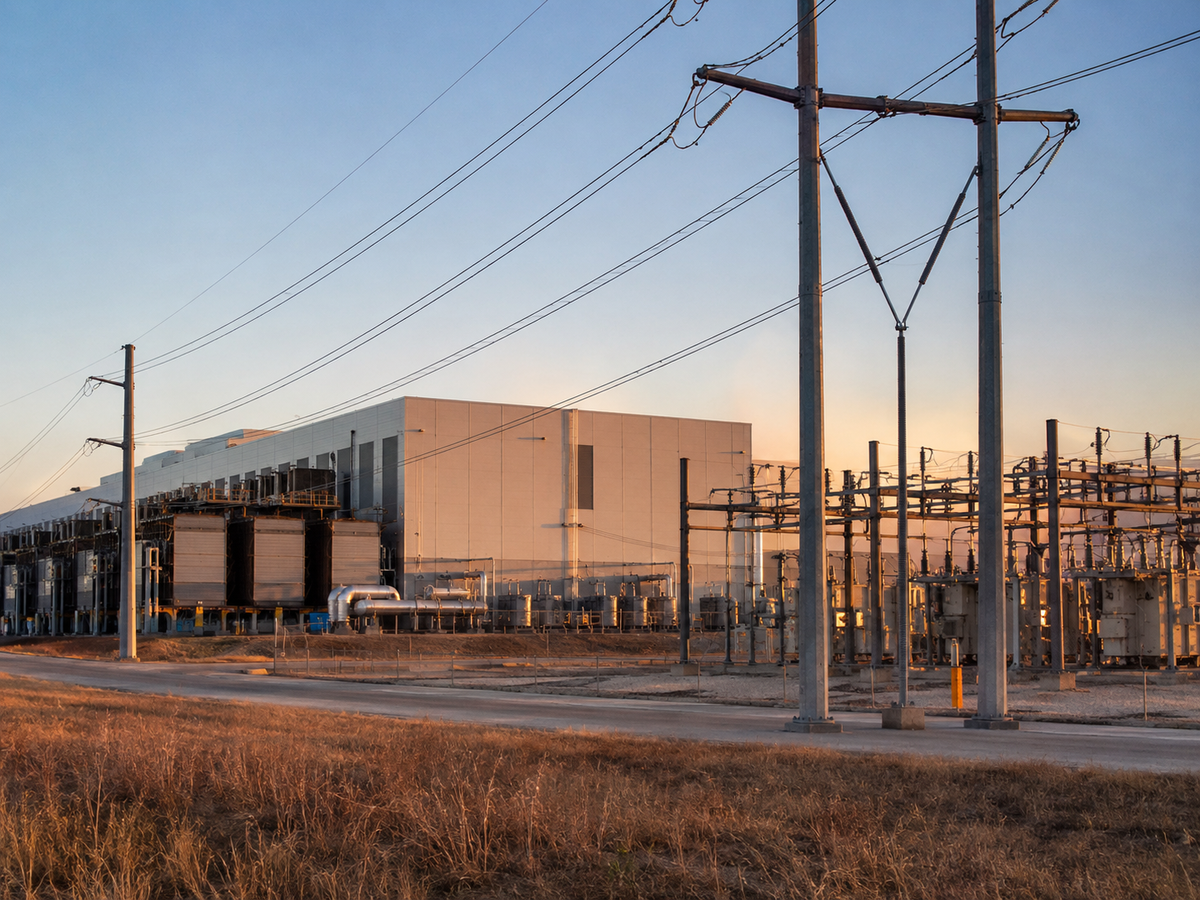
Artificial intelligence (AI) is often described as software, and the instinct is understandable. The visible product is a model, an interface, a search result, a generated image, or a line of code. Yet the legal story becomes more interesting once the analysis moves below the interface. AI depends on physical systems. Those systems need sites, electricity, water, cooling, fiber, financing, permits, tax treatment, and political permission before the digital product can operate at scale.
That is why data centers have captured my attention. They turn a technological shift into an infrastructure problem. The legal work extends beyond technology law because the asset must be acquired, financed, powered, built, permitted, defended, and operated amid changing public expectations.
The energy figures explain why this issue has moved beyond ordinary commercial development. The Department of Energy (DOE) reported that United States data centers consumed about 176 terawatt-hours (TWh) of electricity in 2023, equal to about 4.4 percent of total United States electricity use, and projected that demand could rise to 325 to 580 TWh by 2028. The International Energy Agency (IEA) projects that global data-center electricity consumption could double to about 945 TWh by 2030. The projected 2028 United States data-center load would equal roughly one-third to three-fifths of the IEA’s projected 2030 global data-center electricity figure. That comparison uses different years and different forecast models, so it should be read as a scale reference rather than a precise market-share estimate. Even with that caveat, the buildout is large enough to affect grid planning. In its May 2026 Short-Term Energy Outlook, the United States Energy Information Administration (EIA) forecast rising electricity demand in 2026 and 2027, led by the commercial sector, which includes data centers.
The legal consequence follows from the asset itself. A data center may look like a building, although legally it is closer to a bundle of linked obligations. It requires power contracts, grid access, land-use approvals, water planning, construction risk allocation, tax analysis, financing discipline, and exit optionality. If the facts turn badly, it can also become the center of litigation or political opposition. Few emerging areas make the connection between business judgment and legal structure as visible as this one.
A serious data-center project requires lawyers to move across practice areas while preserving the commercial goal. Site control comes first, although the site must also work for transmission, fiber, water, construction timing, zoning, utility coordination, and local acceptance. Power procurement must follow early because the project’s economics depend on reliable electricity at a workable price. The utility and grid operator then have to assess whether the load can be served while preserving reliability and allocating system costs fairly.
Other legal questions follow from those core constraints. Environmental counsel has to evaluate air permits, water supply, backup generation, wastewater, noise, and opposition risk. Construction counsel has to draft around delays, equipment procurement, liquidated damages, and utility dependence. Finance counsel has to understand the revenue model, tenant structure, power risk, and commercial operation date. The project works only if those pieces fit together.
That kind of work rewards a lawyer who can connect the parts. A technology-only view may miss the infrastructure. A real-estate-only view may miss the power risk. A finance-only view may miss the permitting constraint. The useful lawyer is the one who understands how each issue changes the risk profile of the whole asset.
Major firm practice descriptions point in the same direction. Latham describes its data-center and AI cloud-infrastructure practice as covering site selection for powered land, electricity service agreements, financing, development, permitting, contracting, leasing, operations, and exit strategy. Sidley describes the field through mergers and acquisitions (M&A), joint ventures, real estate, zoning, leasing, environmental permitting, sustainability, water, waste, and noise compliance. The market is already treating data centers as a multidisciplinary legal category rather than a narrow technology issue.
Texas gives the subject a sharper edge. The state has the energy, land, business climate, and political appetite to attract massive infrastructure projects. At the same time, large-load growth creates hard questions about reliability, cost allocation, ratepayer exposure, and speculative projects entering the interconnection queue before their economics are settled. At that point, a private development begins to implicate public governance.
The Public Utility Commission of Texas (PUC) adopted Electric Reliability Council of Texas (ERCOT) Large Load Forecasting Criteria, 16 Texas Administrative Code (TAC) § 25.370, effective March 1, 2026. Texas regulators have also proposed large-load interconnection standards, including standards for projects seeking new interconnections of 75 megawatts or more, to improve planning discipline and reduce stranded-infrastructure risk. Those rules are technical, yet the underlying policy question is inescapable. Which parties should bear the risk when private demand requires public-system upgrades?
The tax side raises a related question about public return. Texas provides a sales-and-use-tax exemption for qualifying data centers and qualifying large data-center projects on certain property used in operation. For qualifying data centers, the exemption applies to Texas state sales and use taxes. For qualifying large data-center projects, it applies to Texas state and local sales and use taxes. An incentive can attract capital and anchor future growth. That case becomes harder to make once the market is large enough to strain infrastructure plans, local budgets, and public tolerance.
Water creates a separate legal risk because scarcity is easier for residents and local officials to grasp than the mechanics of the grid. Interconnection studies can remain technical and remote, while water use appears in permits, utility plans, public meetings, and local headlines. In a dry region, a cooling design can shape the project’s path through permitting, local government review, public opposition, and litigation. Recent reporting on Texas data-center water demand shows why this risk is drawing attention in a state already managing drought, growth, and infrastructure strain.
Houston is a natural place to study this field because its lawyers already work at the intersection of energy, infrastructure, capital projects, sophisticated counterparties, regulatory risk, and political reality. The city’s legal market is built for projects where commercial ambition has to work within physical constraints. AI data centers fit that pattern because they bring new client demand to legal work that still depends on familiar instincts: read the contracts, understand the asset, find the bottleneck, allocate the risk, and keep the project moving.
I am still early in my studies of the field, which is part of its appeal. The rules, market structures, incentive debates, and local opposition are developing while the market is being built. That is the best time to learn a subject, before its questions harden into conventional answers.
The public debate over AI will keep focusing on bias, copyright, privacy, labor, and safety, and those subjects belong in the debate. Data centers add a more physical legal problem. They push the AI boom through property law, utility regulation, public finance, permitting, construction contracts, and litigation. That is why the subject interests me. It shows where a new technology becomes a project that lawyers must structure, finance, defend, and govern.